


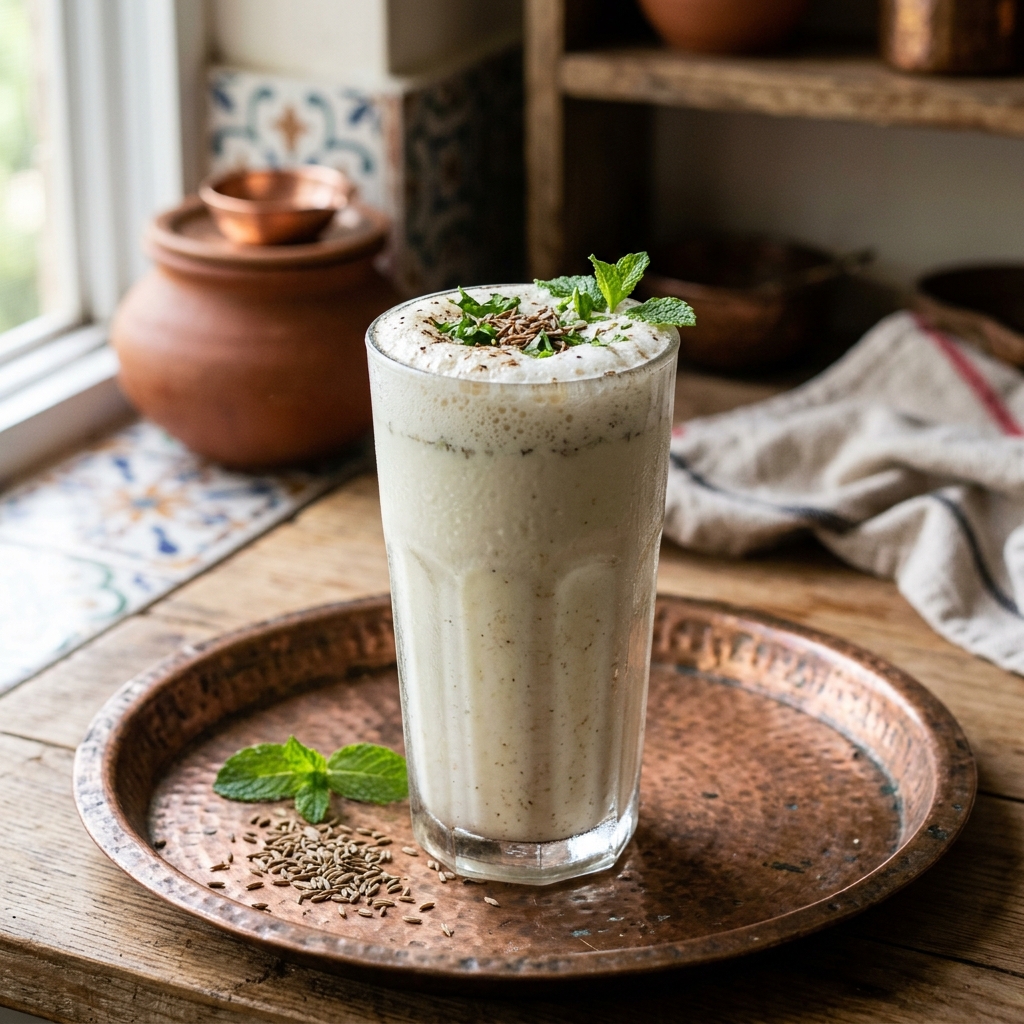
Chaas is a traditional Indian spiced buttermilk drink made by churning fresh curd or yogurt with cold water, roasted cumin, black salt, and fresh herbs. It is light, hydrating, probiotic, and revered for its soothing digestive qualities in warm weather.
Chaas is a thin, savory Indian buttermilk drink made by mixing curd or yogurt with water, salt, spices, and fresh herbs. It is especially common in western, northern, and southern Indian food traditions, though the name and seasoning change by region.
A classic masala chaas may include roasted cumin, black salt, mint, and coriander. South Indian neer mor often adds ginger, green chili, curry leaves, mustard seeds, and hing. In Ayurveda, a related churned curd preparation is called Takra.
This guide covers what chaas is, what it tastes like, how it differs from lassi and Western buttermilk, its Ayurvedic background, regional names, nutrition, live yogurt cultures, and three practical recipes. It also separates traditional health claims from claims that have stronger modern evidence.
Quick Answer: What Is Chaas?
Chaas is a traditional Indian fermented dairy drink made by thinning plain curd or yogurt with water. Savory versions are often seasoned with roasted cumin, salt, coriander, mint, ginger, or other spices. Fresh chaas is normally served cold and is naturally non-alcoholic.
Editorial and health note: The spelling chaach is also widely used across North India. Indian food safety standards (FSSAI) classify chhaach within drinks based on fermented milk, alongside products such as lassi and buttermilk. Health sections in this guide separate traditional Ayurvedic uses from modern clinical trials. This article is for general informational purposes and is not medical advice.
What Does Chaas Taste Like?
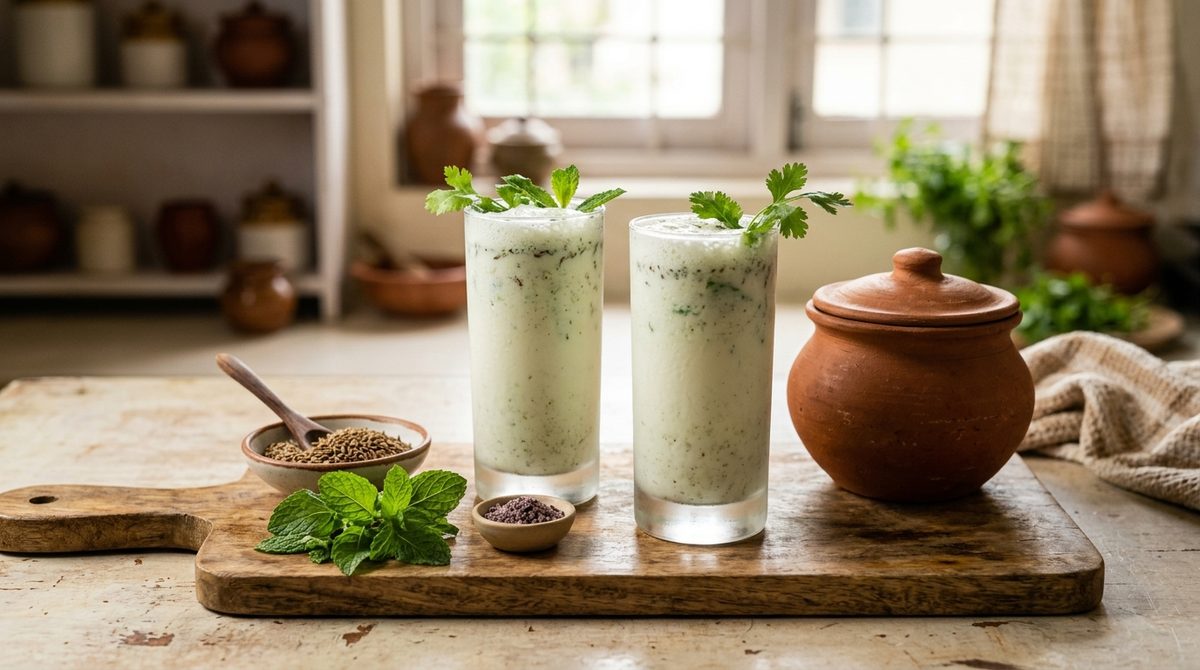
Chaas tastes tangy from cultured dairy and savory from salt and spices. Roasted cumin gives it a warm, toasted aroma. Fresh mint and coriander make the finish clean and herbal. Black salt (kala namak) adds a distinct mineral, slightly sulfuric depth, while ginger or green chili provides gentle, warming heat.
The texture is light, fluid, and pourable, which is one of the clearest sensory differences between chaas and thicker lassi drinks.
Classic North Indian masala chaas is tangy, salty, cumin-forward, and lightly herbal. South Indian neer mor brings a brighter, more complex aromatic profile because it incorporates curry leaves, popped mustard seeds, crushed ginger, green chili, and asafoetida (hing).
Chaas vs Lassi vs Western Buttermilk
While these three beverages are related through cultured dairy, they differ significantly in base ingredients, viscosity, and culinary purpose:
| Feature | Chaas | Lassi | Western Cultured Buttermilk |
|---|---|---|---|
| Base | Curd / yogurt + generous water | Yogurt or dahi + less water | Cultured milk |
| Texture | Thin, fluid, and pourable | Thick, creamy, and viscous | Liquid, slightly thick |
| Taste Profile | Savory, tangy, and spiced | Sweet, fruit-flavored, or salty | Tangy, tart, and acidic |
| Typical Use | Light mealtime refreshment | Filling drink, snack, or dessert | Drink and baking acidifier |
| Calories | Low (30 to 45 kcal per 240 ml) | Moderate to high when sweetened | Depends on milk fat percentage |
Chaas vs. Lassi
The primary distinction between chaas and lassi lies in water dilution and texture. Chaas is heavily diluted (typically 1 part curd to 2.5 or 3.5 parts water) and seasoned with savory spices to aid hydration alongside meals. Lassi uses far less water, retains a rich, velvety consistency, and is frequently sweetened with sugar, mango pulp, or rose syrup.
Chaas vs. Western Cultured Buttermilk
Historically, traditional Western buttermilk was the thin, sour liquid remaining after churning butter from fermented cream. Modern supermarket buttermilk is produced by inoculating pasteurized skim or low-fat milk with lactic acid bacteria. In contrast, Indian chaas is prepared fresh at home by churning or whisking finished curd with cold water and culinary spices.
Why Roasted Cumin Is Used in Chaas
Roasted cumin (bhuna jeera) is the signature aromatic anchor of masala chaas.
Dry-roasting whole cumin seeds triggers complex Maillard reactions and thermal degradation of volatile oils. Food chemistry studies on roasted cumin confirm that heating generates rich heterocyclic aroma compounds, including alkylpyrazines, that produce deep nutty, toasted, and earthy flavor notes absent in raw cumin.
To prepare roasted cumin at home, heat whole seeds in a dry pan over moderate flame until they turn dark amber and release a fragrant aroma. Cool completely before grinding into a coarse powder. Avoid overheating or charring the seeds, which introduces harsh, bitter notes.
What Is Kala Namak (Indian Black Salt)?
Kala namak is a kiln-fired rock salt widely used across South Asian cuisine. Despite its name, the crushed mineral powder displays a distinctive pinkish-grey hue.
Its characteristic savory, sulfurous aroma comes from trace iron sulfides and mineral sulfates. When paired with the natural lactic tang of yogurt and the toasted warmth of cumin, kala namak imparts a complex savory profile that table salt cannot replicate. If unavailable, pink Himalayan rock salt or fine sea salt serves as a clean alternative.
Ayurvedic Takra: How It Relates to Chaas
In classical Ayurvedic literature, Takra refers to churned curd preparations. While modern chaas and Takra are closely related, ancient texts describe specific classifications based on the degree of fat removal and water dilution:
1. Ghola: Churned curd without water addition and with full fat retained.
2. Mathita: Churned curd without water, with the cream layer skimmed off.
3. Takra: Curd churned with one-fourth part water and fat removed.
4. Udasvit: Curd churned with equal parts water.
5. Chhachhika: Curd churned with substantial water, fully skimmed of butter fat.
Classical texts describe Takra as possessing amla (sour) and kashaya (astringent) tastes, with laghu (light) and deepana (digestive fire stimulating) qualities. Traditional practice recommends freshly churned Takra alongside midday meals.
History of Chaas and Dairy Churning in India
Cultured dairy has formed an integral part of South Asian agriculture and cuisine for millennia. Vedic texts contain numerous references to milk processing, curd setting, and butter churning.
While historical traditions describe dairy churning in everyday households, modern spiced chaas evolved gradually through regional culinary adaptation. The epic mythology of Samudra Manthan (the Churning of the Cosmic Ocean) reflects how deeply dairy churning was embedded in ancient Indian cultural consciousness.
What Is a Madhani?
A madhani (or mathani) is a traditional South Asian wooden hand churn featuring grooved fins at the base. Held upright inside a clay or brass pot and spun rapidly back and forth with a cord or palms, it separates cultured butter (makkhan) from the remaining buttermilk while whipping air into the liquid to create a frothy crown.
How to Make Classic Masala Chaas (Recipe 1)
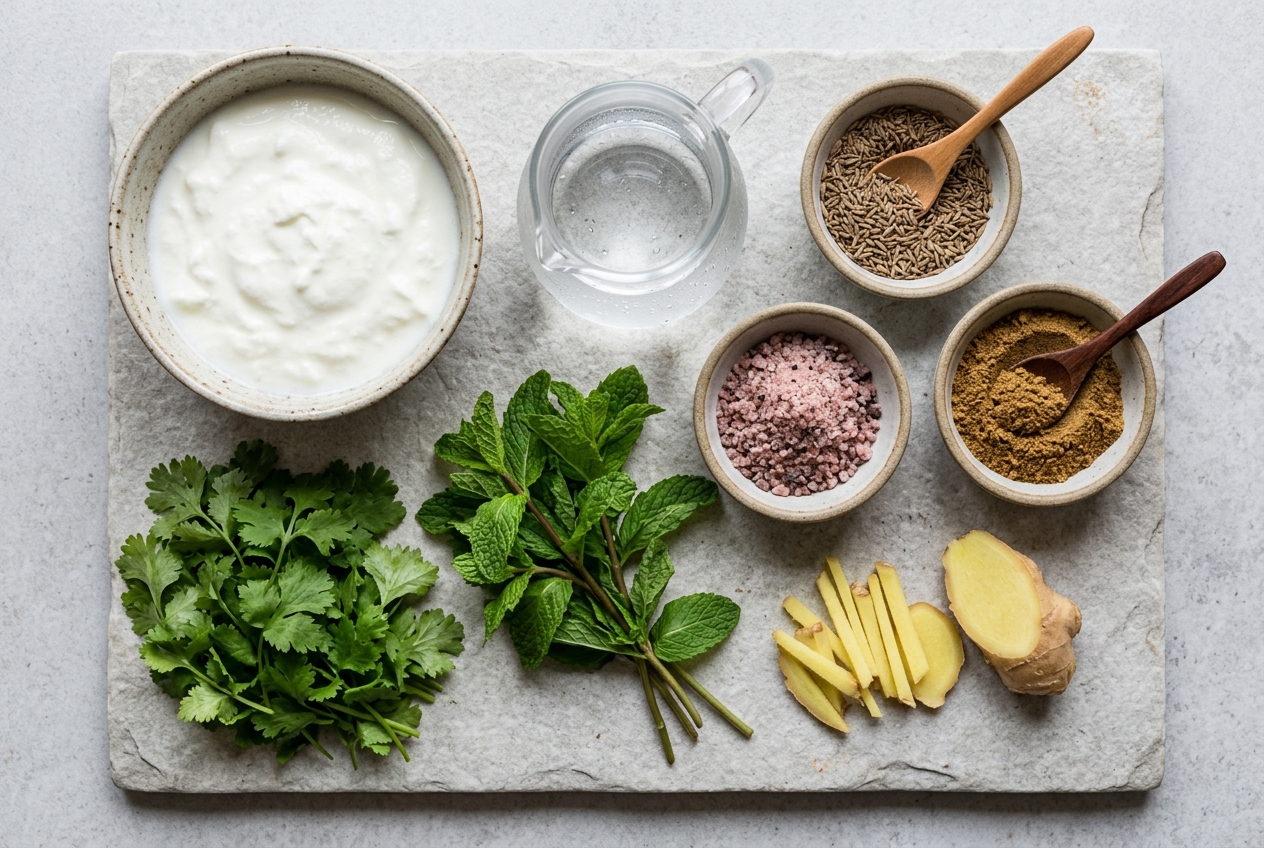
This refreshing, froth-topped North Indian recipe makes two large glasses of classic spiced buttermilk.
Yield: 2 to 3 servings | Prep time: 5 minutes | Style: Classic Savory Frothy Chaas
| Ingredient | Quantity | Culinary Role |
|---|---|---|
| Plain whole-milk or low-fat curd (yogurt) | 1 cup (240 g) | Cultured dairy base providing lactic tang and body |
| Chilled filtered water | 2.5 cups (600 ml) | Dilutes curd to a light, pourable consistency |
| Roasted ground cumin (bhuna jeera) | 1/2 tsp | Toasted aromatic warmth and earthy depth |
| Black salt (kala namak) | 1/2 tsp (or to taste) | Savory mineral depth and authentic flavor |
| Fresh mint leaves | 8 to 10 leaves (torn) | Crisp cooling freshness |
| Fresh coriander (cilantro) | 1 tbsp (finely chopped) | Bright herbal aroma and green flecks |
Step-by-Step Method
- Smooth the curd: Place 1 cup of plain chilled curd in a mixing bowl or blender jug. Whisk vigorously with a wire whisk or blend for 10 seconds until completely smooth.
- Add water in stages: Pour in 2.5 cups of cold water while whisking continuously until the mixture is uniform and fluid.
- Season with spices: Add the roasted ground cumin and black salt. Whisk to dissolve evenly.
- Incorporate fresh herbs: Add finely chopped coriander and torn mint leaves.
- Froth and chill: Blend for 15 seconds or churn briskly with a whisk until a light froth forms on the surface.
- Serve cold: Pour into tall glasses, garnish with a pinch of roasted cumin and a mint sprig, and serve immediately.
South Indian Neer Mor Recipe (Recipe 2)
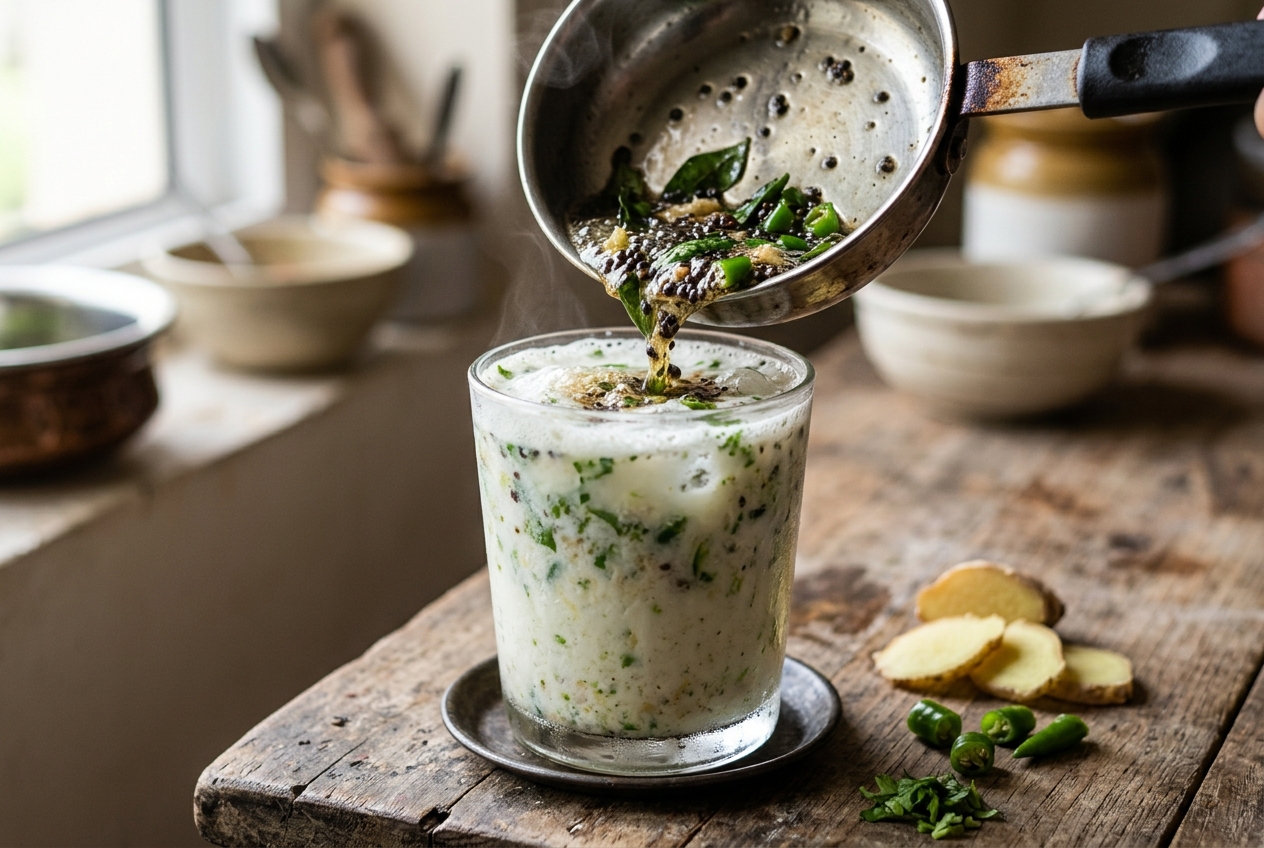
Neer mor (also known as moru or majjige) is a tempered South Indian buttermilk celebrated for its cooling properties in hot weather and traditionally served during festivals like Rama Navami.
Yield: 3 to 4 servings | Prep time: 8 minutes | Style: Tempered Mustard & Curry Leaf Buttermilk
| Ingredient | Quantity | Culinary Role |
|---|---|---|
| Plain yogurt / dahi | 1 cup | Smooth fermented base |
| Cold water | 3.5 cups | High dilution for maximum hydration |
| Fresh ginger | 1/2 inch (finely minced) | Zesty heat and digestive warmth |
| Green chili | 1 small (slit or minced) | Subtle spicy kick |
| Mustard seeds | 1/2 tsp | Nutty crunch in hot tempering |
| Curry leaves | 6 to 8 fresh leaves | Distinctive South Indian botanical aroma |
| Asafoetida (hing) | 1 pinch | Savory umami depth |
| Coconut oil or sesame oil | 1 tsp | Tempering medium for spices |
| Salt | To taste | Balances tang and herbal flavors |
Step-by-Step Method
- Whisk the base: Whisk 1 cup yogurt with 3.5 cups water until light and thoroughly thinned.
- Infuse ginger and chili: Add minced ginger, slit green chili, and salt. Stir well and let rest for 5 minutes.
- Prepare the tadka (tempering): Heat 1 teaspoon of oil in a small tadka pan. Add mustard seeds and let them crackle. Add curry leaves and a pinch of asafoetida (hing), allowing them to fry for 5 seconds until aromatic.
- Pour tadka into buttermilk: Immediately pour the sizzling seasoned oil over the cold buttermilk. Stir gently to distribute the tempered spices.
- Strain or serve rustic: Serve chilled in earthenware or steel tumblers.
Plain Ayurvedic Takra Recipe (Recipe 3)
A minimalist, high-dilution preparation designed for gentle post-meal hydration following traditional principles.
Yield: 2 servings | Prep time: 3 minutes | Style: Gentle Ayurvedic Digestive Buttermilk
| Ingredient | Quantity | Purpose |
|---|---|---|
| Fresh cultured curd (dahi) | 1/2 cup | Unpasteurized live-culture base |
| Room-temperature water | 2 cups | Gentle dilution adhering to Ayurvedic guidelines |
| Rock salt (saindhava lavana) | 1 pinch | Mineral seasoning without overheating |
| Roasted cumin powder | 1 pinch | Aromatic carminative spice |
Step-by-Step Method
- Churn the curd: Whisk 1/2 cup fresh curd briskly until smooth and uniform.
- Add room-temperature water: Pour in 2 cups of water gradually, whisking to achieve a light, pourable consistency.
- Season lightly: Add a small pinch of rock salt and roasted cumin powder.
- Serve fresh: Sip slowly following lunch to complement midday digestion.
Regional Variations and Names Across India
Buttermilk traditions vary widely across Indian states, reflecting regional climate, agricultural traditions, and spice preferences:
| Regional Name | Geographic Region / Language | Signature Preparation Traits |
|---|---|---|
| Chaas / Chaach | Gujarat, Rajasthan, Uttar Pradesh, Delhi | Roasted cumin, black salt, mint, coriander; often whipped frothy |
| Taak | Maharashtra | Ginger, salt, coriander, and light green chili; subtly seasoned |
| Majjige | Karnataka and Andhra Pradesh | Crushed ginger, curry leaves, green chili, and lemon notes |
| Neer Mor / Moru | Tamil Nadu and Kerala | Heavily thinned; seasoned with mustard tadka, curry leaves, and hing |
| Ghol | West Bengal | Lightly salted, occasionally sweetened, often paired with fragrant Gondhoraj lime |
Chaas Calories and Nutrition Facts
For a standard 240 ml glass of homemade masala chaas prepared at a typical 1:2.5 curd-to-water ratio, working nutritional estimates include:
| Nutrient | Working Estimate (per 240 ml glass) | Nutritional Context |
|---|---|---|
| Calories | 30 to 45 kcal | Low energy density due to high water dilution |
| Protein | 2.5 to 3.5 g | Provides complete dairy protein and branched-chain amino acids |
| Fat | About 1 g (whole milk curd) | Significantly lower than whole milk or lassi |
| Carbohydrates | About 4 g | Natural milk lactose; zero added sugars in savory recipes |
| Potassium | About 140 mg | Electrolyte supporting fluid balance |
| Sodium | About 160 mg | Derived from added black salt and culinary seasonings |
| Calcium | About 100 mg | Bioavailable calcium supporting bone health |
Chaas Benefits: What Does the Science Support?
Evaluating the wellness attributes of chaas requires distinguishing between established nutritional science and traditional folk claims.
Lactose digestion support: Plain yogurt is fermented with starter cultures including Streptococcus thermophilus and Lactobacillus delbrueckii subsp. bulgaricus. European health authorities (EFSA) and clinical trials confirm that viable yogurt cultures improve the in vivo digestion of lactose in individuals with lactose maldigestion.
Hydration and electrolyte support: Because chaas consists of roughly 70% to 80% water combined with natural potassium and sodium from seasoning, it provides effective, refreshing dietary hydration during warm summer weather.
Weight management support: Unsweetened chaas contains only 30 to 45 calories per glass. Choosing savory chaas over sugary soft drinks or sweetened lassis can help lower daily caloric intake as part of a balanced diet.
Digestion and gastrointestinal boundaries: While traditional Ayurveda links Takra with digestive comfort, chaas should not be promoted as a clinical cure for acid reflux, GERD, or inflammatory bowel disorders. Individuals with severe dehydration or acute gastrointestinal illnesses require proper medical hydration therapy.
Is Chaas Probiotic? Understanding Live Cultures
While yogurt and curd are cultured dairy products, the term probiotic has a precise scientific definition established by ISAPP (International Scientific Association for Probiotics and Prebiotics): live microorganisms that, when administered in adequate amounts, confer a health benefit on the host.
Standard yogurt starter strains (L. bulgaricus and S. thermophilus) provide proven lactose-digestion benefits. However, homemade chaas has variable live culture counts depending on curd freshness, temperature, and water dilution. It is best enjoyed as a wholesome cultured food rather than a standardized clinical probiotic supplement.
Tips for Making the Best Masala Chaas at Home
Follow these culinary principles for restaurant-quality buttermilk at home:
1. Start with fresh, unsweetened curd: Overly sour or aged curd will overpower the delicate spices. Use freshly set, mild curd.
2. Whisk the yogurt before adding water: Whisking the curd smooth prior to dilution prevents lumpiness and produces a velvety texture.
3. Control water dilution in stages: Pour cold water gradually until the consistency matches your personal preference.
4. Freshly roast cumin: Never use pre-ground raw cumin. Freshly roasted and ground cumin provides unmatched aroma.
5. Add fresh herbs at the finish: Stir in torn mint and cilantro right before serving to maintain bright green color and crisp aromatics.
How Chaas Compares to Other Traditional Beverages
Chaas represents a unique savory expression within the global spectrum of traditional heritage drinks and fermented wellness tonics:
- Golden Milk (Haldi Doodh): While chaas is a chilled, savory cultured dairy drink for daytime digestion, warm golden milk provides comforting turmeric and spices as an evening beverage.
- Japanese Amazake: Japan's traditional sweet rice beverage derives natural glucose through koji enzyme saccharification, contrasting with the savory lactic profile of chaas.
- Peruvian Chicha Morada: Peru's iconic purple corn brew offers rich fruit spices and anthocyanin antioxidants for non-dairy refreshment.
- Colombian Aguapanela & Guarapo: Latin American sugarcane beverages deliver natural sucrose and mineral caramel sweetness compared to savory fermented dairy.
- Traditional Malt Drinks: Malted grain beverages supply complex B vitamins and roasted grain body for alcohol-free nourishment.
- Fermented Tepache & Ginger Beer: For lovers of wild carbonation and zesty ginger, fermented pineapple tepache and craft ginger beer provide sparkling probiotic complexity.
- Botanical Sparkling Teas: Cold-brewed sparkling teas offer refined tannins and floral elegance for mindful adult dining.
- Plant-Based Drinks & Non-Alcoholic Drinks: Explore our complete guide to botanical infusions, dairy-free alternatives, and zero-proof refreshments.
Frequently Asked Questions About Chaas
What is chaas?
Chaas is an Indian fermented dairy drink made by thinning plain curd or yogurt with water and seasoning it with savory spices like roasted cumin, salt, mint, coriander, and ginger.
Is chaas the same as Western buttermilk?
No. Chaas is made fresh by blending yogurt with water and spices. Traditional Western buttermilk was the byproduct of butter churning, while modern Western buttermilk is cultured milk.
What is the difference between chaas and lassi?
Chaas is thin, heavily diluted with water, and savory. Lassi is thicker, richer in dairy content, and frequently sweetened with sugar, mango, or rose syrup.
Why is roasted cumin used instead of raw cumin?
Roasting cumin seeds causes Maillard reactions that release aromatic alkylpyrazines, giving the spice a warm, nutty, and toasted flavor profile that enhances savory buttermilk.
Is chaas good for digestion?
Chaas has a long traditional post-meal role in India. Live yogurt cultures can improve lactose digestion for people with lactose intolerance, though chaas is not a clinical treatment for digestive diseases.
How many calories are in chaas?
A standard 240 ml glass of homemade masala chaas contains approximately 30 to 45 calories, making it a light, hydrating beverage option.
What is neer mor?
Neer mor is a South Indian variation of seasoned buttermilk tempered with mustard seeds, curry leaves, ginger, green chili, and asafoetida (hing).
What is Takra?
Takra is a classical Ayurvedic churned curd preparation with specific ratios of water and fat removal, traditionally used to support digestive balance.
Sources and References
- Food Safety and Standards Authority of India (FSSAI): Dairy Products and Analogues Standards
- National Dairy Development Board (NDDB): Fermented Dairy Products
- Gebreselassie et al. / Int J Dairy Technol: Chemical Composition of Naturally Fermented Buttermilk
- Elmassry et al. / J Chromatogr B: Metabolome Based Volatiles Mapping of Roasted Umbelliferous Fruits Aroma
- Shoban S. et al.: The Ayurvedic Significance of Buttermilk - A Nutritional and Therapeutic Perspective
- PubMed Central (PMC): Improvements in Makkhan (Traditional Indian Cultured Butter) Production: A Review
- FSSAI Eat Right India: Traditional Neer Mor Recipe Guidance
- U.S. FDA: Microorganisms and Microbial-Derived Ingredients Used in Food (Yogurt Identity Standards)
- European Commission: EU Register on Nutrition and Health Claims (Live Yoghurt Cultures & Lactose Digestion)
- Savaiano et al. / Am J Clin Nutr: Strains and Species of Lactic Acid Bacteria in Fermented Milks: Effect on In Vivo Lactose Digestion
- Hill et al. / ISAPP Consensus / Nat Rev Gastroenterol Hepatol: Expert Consensus Document on the Scope and Appropriate Use of the Term Probiotic


Comments and reviews (0)