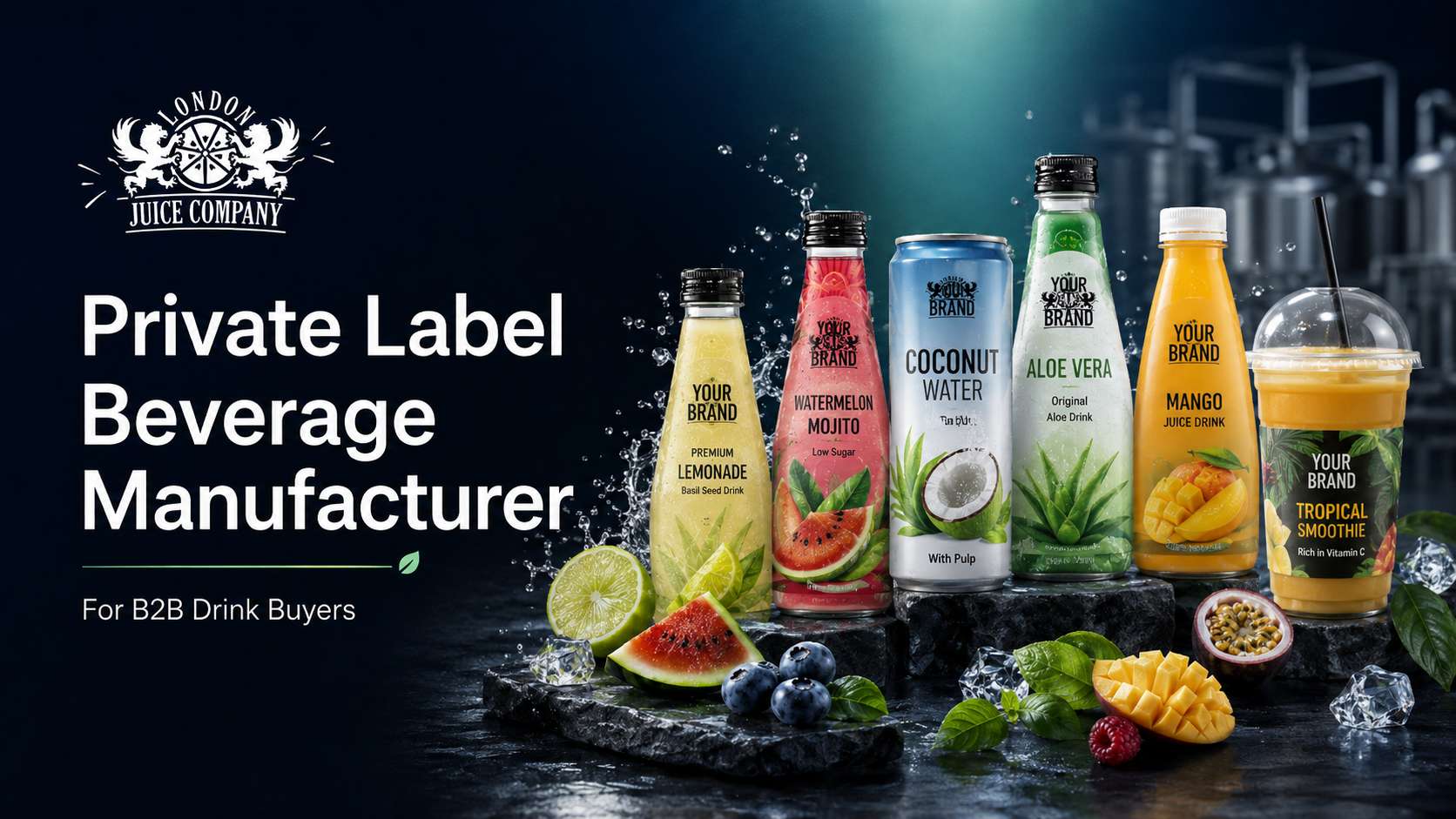
London Juice Company works with B2B buyers who want to put their own brand on a drink range. That includes private label orders for retailers, exclusive supply for distributors and OEM manufacturing discussions for buyers who want full customisation.Private label beverage manufacturing is not a single conversation. It depends on what you want to produce, which market you are selling into, what volume you can commit to and how much lead time you have. That is why enquiries are reviewed individually rather than handled with a standard price list.If you are researching the feasibility of an own-brand drink range, this page explains how London Juice Company approaches private label and what buyers typically need to have ready before the conversation starts.
In beverage trade, private label means a product manufactured and filled by one company, then sold under the buyer's own brand name. You control the label, the brand and the market positioning. The manufacturer handles production, filling, quality control and export documentation.
OEM manufacturing goes further. It typically involves custom formulation, packaging development and full product creation from scratch. London Juice Company has the production infrastructure across four sites in Vietnam, Thailand, Malaysia and Turkey to handle both approaches depending on category, volume and buyer requirements.
| Drink Category | Reference Products | Formats |
| Alcohol-free mocktails | Mr. Mojito | 250ml can, 275/330ml glass, 500ml/1L PET |
| Basil seed drinks | Mr. Basil | 250ml can, 290ml glass, 1L PET, Falooda glass |
| Aloe vera drinks | Mr. Aloe | Bottle and glass options |
| Coconut water | RAW Coco Burst | Multiple formats with real coconut pulp |
| Tropical juice drinks | Tropical Dream | Bottle and glass packaging |
Use the existing London Juice Company brands as a reference point for what product categories are available and what formats are realistic for your market.
Supermarkets, convenience chains and specialist drink retailers can build a beverage range under their own label when the category, volume and margin model make sense. Private label gives them brand control without the cost and risk of building a factory supply chain from scratch.
Importers and regional distributors sometimes need a labelled product that is exclusive to their territory or channel. That could be a specific flavour range, a format not available in branded stock or a co-branded product built for a particular market.
Hotels, event groups and food service operators occasionally want a branded beverage that carries their own name or venue identity. A ready-to-drink own-brand mocktail, juice or aloe drink can be a premium touch on a menu or minibar that standard stock cannot replicate.
| Buyer Type | Why Private Label Makes Sense |
| Supermarkets and retail chains | Own-label drink range with margin control and brand consistency |
| Regional distributors | Territory-exclusive product line for a defined customer base |
| Hospitality groups | Branded non-alcoholic beverages for venues and events |
| Import buyers | Market-specific packaging, label language and compliance requirements |
Private label feasibility depends on several variables. Having these ready speeds up the initial conversation significantly.
The clearest starting point is to review the existing brand portfolio and the product catalogue to identify which drink categories and formats match your market need.
Then contact London Juice Company with your country, buyer type, product category interest, estimated volume and any specific packaging or compliance requirements. The team will review the enquiry and come back with a realistic picture of what is feasible.
Yes. Private label and OEM drink enquiries are reviewed case by case. Feasibility depends on product category, order volume, packaging requirements, target market and production lead time.
Send your country, buyer type, drink category, estimated volume, preferred format, required compliance documentation and expected launch date. The more detail you can provide, the faster the initial assessment can be completed.
Yes. The existing product portfolio is the most practical reference for understanding what categories and formats are available. Many private label discussions start with a buyer pointing to a specific product and asking whether it can be produced under their own brand.
Private label MOQs depend on the product type, format and production requirements. This varies by category. Share your volume estimate during the initial enquiry and the team will confirm what is workable.
Yes. Production facilities operate under halal certification alongside ISO 9001, ISO 22000, BRC, FSSC 22000, HACCP and GMP standards. Private label products produced through London Juice Company can carry relevant certifications subject to buyer requirements and specific product details.


