


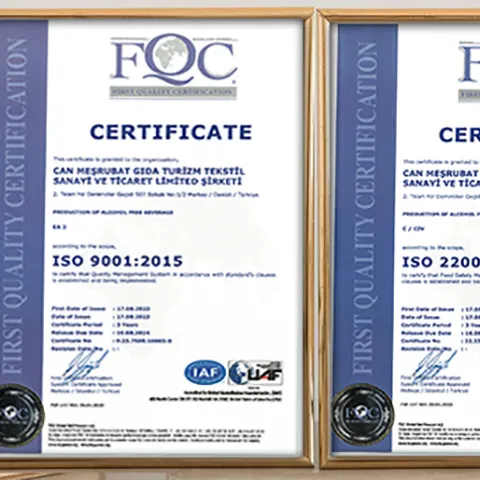
ISO certified beverages is a common phrase for drinks made within a certified management system. It usually refers to the producer's processes and the scope shown on its certificate. It does not mean ISO has tested or approved each bottle.
What Does ISO Certified Beverage Mean?
ISO certified beverages are drinks manufactured in facilities whose management systems have been independently audited against international food safety standards like ISO 22000 or schemes like FSSC 22000. System certification evaluates operational discipline, hazard controls, and traceability within a defined certificate scope rather than inspecting or certifying individual bottles.
Important Safety Note: This technical guide outlines management system certification standards, audit processes, and verification methods. It does not constitute a certification decision, a legal assessment, or an authorized operating procedure for beverage manufacturing facilities. Facility owners and commercial buyers must verify specific certificate scopes, statutory food safety duties, and site validations with qualified authorities.
This guide explains what certification can show, how audits work, and what evidence buyers should check.
What Does an ISO Certified Beverage Mean?
ISO develops standards, but external accredited certification bodies assess organizations against the relevant requirements and issue certificates. ISO does not certify facilities directly.
A food safety management system (FSMS) organizes operational responsibilities, hazard controls, cross-functional communication, verification checks, and continuous improvement. Certification provides independent assessment of that system within a defined scope.
The scope is critical. A certificate for storing sealed ambient drinks may not cover blending, pasteurization, or bottling operations. Similarly, a certificate granted to one factory does not automatically cover secondary facilities owned by the same group.
Certification provides useful evidence for technical supplier approval. It cannot guarantee that every individual production batch is entirely free of defects, that finished labels comply with every regional regulation, or that recall risks are eliminated.
For the wider production context, see how beverage manufacturers ensure food safety across commercial operations. This guide focuses specifically on standards, certification, audits, and buyer checks.
What Certification Does Not Tell a Shopper
A management system certificate does not establish a beverage's nutritional profile, sugar content, vitamin level, sensory taste, or dietary suitability. It does not automatically signify that a beverage is organic, vegan, kosher, halal, gluten-free, or allergen-free.
Retail shoppers and commercial procurement officers should evaluate nutrition panels, ingredient declarations, and product-specific certifications separately. When specialized label claims matter, buyers should request validated third-party verification under the appropriate regulatory programs.
ISO 9001, ISO 22000, and Other Beverage Standards
The standard number defines the subject matter, while the edition identifies the revision year. Technical buyers should never assume all ISO certificates govern food safety:
| Standard or Scheme | Main Purpose | Beverage Example | Important Boundary |
|---|---|---|---|
| ISO 9001 | Quality management | Recipe control, fill consistency, complaints, and improvement | Not a substitute for a validated food safety system |
| ISO 22000 | Food safety management | Hazard assessment, operational controls, communication, and verification | System certification is not individual product batch approval |
| FSSC 22000 | GFSI-recognized food safety certification scheme built on ISO 22000 | ISO 22000 plus sector prerequisite standards and scheme requirements | Check version, scope, status, and buyer acceptance |
| ISO 14001 | Environmental management | Water reduction, effluent discharge, energy conservation, and packaging waste | Not proof of beverage safety or environmental product claims |
| ISO 45001 | Occupational health and safety management | Worker ergonomics, bottling line guarding, and chemical handling protocols | Not food safety certification |
ISO 9001 Versus ISO 22000
A beverage quality management system assists an organization in controlling technical specifications, investigating customer complaints, and improving processing consistency. Concrete examples include maintaining agreed net fill volumes, managing recipe versioning, or verifying carton pallet counts.
ISO 22000 addresses food safety management specifically. It combines interactive system management, cross-functional communication, prerequisite programs, and hazard analysis based on Codex Alimentarius HACCP principles.
An organization can integrate these management frameworks. However, possessing an ISO 9001 certificate alone does not constitute proof that juice processing controls pathogenic microorganisms.
Check the Edition and Transition Status
ISO lists ISO 9001:2026 and ISO 14001:2026 in its current catalogue. ISO 22000:2018 remains the published food safety management edition, alongside a 2024 amendment. A draft standard under review is not equivalent to an active standard in force.
The publication of a revised edition does not render existing certificates immediately invalid. Buyers should consult the accredited certification body regarding active transition schedules and evaluate the current audit status rather than judging validity solely by edition year.
ISO 22000 Versus FSSC 22000
ISO 22000 is an international management standard. FSSC 22000 is a comprehensive certification scheme that combines ISO 22000 with sector-specific prerequisite programs (PRPs) and targeted FSSC scheme additions.
Prerequisite programs establish basic environmental and operational conditions necessary for safe food manufacturing. These encompass hygienic premises design, water and utility controls, personnel sanitation, cleaning protocols, and pest exclusion, supporting product-specific hazard plans.
| Question | ISO 22000 | FSSC 22000 |
|---|---|---|
| What is assessed? | Conformity with the food safety management standard | ISO 22000, relevant sector PRPs, and FSSC scheme requirements |
| Is it the same as product testing? | No | No |
| Is standalone ISO 22000 GFSI-recognized? | No | Recognition relates to the specified FSSC program version and scopes |
| Are there scheme-specific additions? | Not the FSSC package | Requirements include areas such as food fraud, food defense, and applicable environmental monitoring |
| Does it guarantee a supermarket listing? | No | No; the buyer still approves suppliers and products independently |
Food fraud concerns intentional deception for commercial gain, such as dilution or unauthorized ingredient substitution. Food defense addresses malicious contamination or intentional harm. While industry often references terms like VACCP and TACCP, an acronym alone does not prove operational efficacy.
FSSC Version 6 and Version 7: What Changed?
Prerequisite standards vary across FSSC versions. FSSC Version 6 utilizes the ISO/TS sector specifications designated for that version. Version 7 transitions to the updated 2025 ISO 22002 standard architecture.
For beverage processing under this structure, common baseline requirements in ISO 22002-100:2025 apply in conjunction with sector-specific standard ISO 22002-1:2025. Technical buyers should not assume ISO 22002-100 alone addresses all processing requirements.
| FSSC Milestone | Published Timing |
|---|---|
| Version 7 release | 1 May 2026 |
| Last permitted Version 6 audits | 30 April 2027 |
| Version 7 upgrade audit window | 1 May 2027 to 30 April 2028 |
These milestones reflect official guidance from FSSC. Manufacturers must verify applicable audit criteria with their certification body prior to scheduling audits. Valid Version 6 certificates remain fully legitimate throughout the designated transition period.
What GFSI Recognition Means for Beverage Buyers
The Global Food Safety Initiative (GFSI) benchmarks certification schemes. It does not certify individual bottling facilities or approve commercial beverages directly.
GFSI's directory of recognized certification programs specifies benchmarked schemes and scopes. Procurement teams should verify listed versions and relevant food chain categories. The publication of a new scheme version does not automatically confer immediate GFSI recognition on that version.
FSSC represents one prominent benchmarked option alongside programs such as BRCGS, IFS, and SQF. The optimal choice depends on production activity, export markets, and retailer policy. Buyers should never assume major supermarket chains operate under identical global supplier acceptance rules.
How the System Applies to Juice and Other Drinks
While management frameworks remain consistent across categories, operational controls must match the specific drink. A fruit juice, a dairy alternative, and an effervescent tea cannot operate under a single generic hazard analysis:
| Area | What the Team Should Assess | Evidence a Buyer May Request |
|---|---|---|
| Ingredients and suppliers | Contamination, allergens, authenticity, and relevant residues | Specifications, approval criteria, and incoming records |
| Water and utilities | Suitability for the intended use and contamination through distribution | Source, treatment, maintenance, and relevant results |
| Treatment | Hazards and validated process conditions | Validation basis and linked monitoring records |
| Filling and closure | Contamination after treatment and package integrity | Hygienic controls, checks, and response to failure |
| Storage and transport | Conditions required for the product | Storage limits, relevant logs, and handling instructions |
Biological hazards include pathogens like Escherichia coli, Salmonella enterica, or Listeria monocytogenes. Chemical hazards encompass allergen cross-contact, CIP chemical carryover, or patulin in apple juice. Physical hazards involve glass fragments from bottling failures, plastic shards, or metal shavings.
Spoilage microflora such as Alicyclobacillus acidoterrestris and osmophilic yeasts degrade sensory quality and shelf stability. Spoilage microorganisms must not be conflated with the target pathogens identified in regulatory safety validation. Mechanical cold pressing describes extraction without thermal degradation; it does not achieve microbial lethality. Review our cold-pressed juice versus regular juice guide for detailed processing contrasts.
HACCP, PRPs, OPRPs, and CCPs
HACCP (Hazard Analysis and Critical Control Point) structures foundational safety through hazard evaluation, CCP selection, critical limit definition, continuous monitoring, and documented corrective actions.
ISO 22000 incorporates Operational Prerequisite Programs (OPRPs) for control measures identified through formal hazard analysis. An OPRP is not merely a secondary CCP; the food safety team must justify whether a measure is governed as a CCP with measurable critical limits or an OPRP with verifiable action criteria.
Pasteurization is not automatically the sole CCP on every beverage line, nor is routine line sanitation automatically categorized as a CCP. The facility plan must establish defensible hazard boundaries. For complete plan design, examine our master guide on HACCP in beverage manufacturing.
Treatment Validation and Monitoring
There is no single universal thermal schedule or High-Pressure Processing (HPP) parameter mandated by ISO. Process lethality depends upon beverage pH, water activity, target organisms, packaging format, and distribution temperatures. Certification cannot validate recipe modifications without technical studies.
Under FDA regulations (21 CFR Part 120), juice processors must achieve a validated 5-log reduction in the pertinent pathogen. Monitoring instruments must capture deviations swiftly. Consult our detailed juice HACCP monitoring guide for instrumentation calibration, log maintenance, and deviation management.
Facility Hygiene, Water, and Cleaning
Hygienic facility engineering prevents contamination and supports sanitation. Facility zoning must segregate incompatible workflows, separating raw agricultural intake from exposed post-pasteurization packaging areas.
Process water must meet strict drinking water standards. Water treatment configurations, including reverse osmosis, carbon filtration, or ultraviolet irradiation, should reflect raw water quality rather than speculative marketing templates. For structural plant hygiene benchmarks, review our guide on GMP-certified beverages.
CIP, Sanitizing, and Verification
Clean-in-Place (CIP) systems circulate detergents and sanitizers through processing loops without equipment dismantling. Cleaning removes organic and mineral soils, while sanitizing reduces surviving microbes to acceptable levels. Standard CIP does not achieve commercial sterilization.
Sanitation verification requires disciplined testing. Neutral final rinse pH demonstrates chemical removal but does not confirm microbial clearance. Similarly, ATP bioluminescence swabs monitor general biological cleanliness but cannot prove allergen absence. Documented line clearance must precede operational startup.
A Non-Operational Sanitation Readiness Review
Technical auditors and quality teams can evaluate sanitation programs using this structured non-operational evidence checklist:
| Review Question | Evidence to Examine |
|---|---|
| Is the method suitable? | Approved procedure, equipment compatibility, and validation basis |
| Are chemicals controlled? | Product instructions, identity, concentration checks, and handling provisions |
| Are hard-to-clean areas covered? | Circuit and equipment assessment, including relevant seals and nozzles |
| Are checks meaningful? | Suitable sampling locations, methods, and justified criteria |
| Are failures handled? | Product and line hold, root-cause investigation, corrective action, and authorized restart |
Allergen control requires strict raw material qualification, dedicated storage, validated line changeover procedures, and accurate label verification. Operators must never rely solely on a rapid swab result while mismatched packaging remains present in the packaging bay.
Traceability, Mass Balance, and Mock Recalls
Traceability connects received ingredients, internal batching, packaging materials, and outbound shipping records. A dependable system must trace finished lots back to incoming agricultural components and track compromised lots forward to commercial distributors.
Mass balance exercises determine whether ingredient inputs match finished outputs. For example, in a 1,000 kg batch, accounting might document 950 kg packaged, 30 kg retained in work-in-process holding tanks, and 20 kg measured line loss. Discrepancies must trigger investigations rather than being obscured by broad yield tolerances.
Mock recall drills test communications, record accessibility, and reconciliation efficiency under simulated emergency constraints. While consumer QR codes provide transparency, they do not replace secure plant batch records; see our analysis on why juice bottles have QR code labels for consumer packaging distinctions.
ISO Certification Audit Steps for Beverage Plants
Achieving accredited certification requires a disciplined six-stage implementation journey:
1. Choose the Scope and Certification Basis: Define operational activities, physical locations, product lines, and relevant food-chain categories. Verify buyer mandates and select an accredited certification body with verified sector competence.
2. Assess Gaps and Implement the System: Assign executive leadership responsibilities, evaluate baseline hazards, establish prerequisite programs, and address operational nonconformities through evidence-based Plan-Do-Check-Act (PDCA) cycles.
3. Run Internal Audits and Management Review: Audit operations against standard requirements across multiple production shifts. Management review must translate identified gaps into dedicated resources.
4. Complete Stage 1 Audit: Certification auditors evaluate documented procedures, operational scope, and facility preparedness to determine readiness for full implementation assessment.
5. Complete Stage 2 Audit: Auditors conduct extensive on-site evaluations, sampling operational logs, interviewing operators, and observing real-time processing conformity against audit criteria.
6. Resolve Findings and Maintain Certification: Address minor and major nonconformities through root-cause analysis. Accredited certificates require annual surveillance audits, including mandatory unannounced audits under FSSC Version 6.
How to Check a Beverage Supplier's Certificate
Procurement teams should examine the complete official certificate rather than relying on promotional summaries. Match certificate details against intended manufacturing parameters:
| Check | What to Confirm |
|---|---|
| Organization and site | Exact legal entity name, corporate address, and relevant manufacturing locations |
| Standard and edition | Correct subject standard, published edition version, and active transition basis |
| Scope | Relevant processing activities, beverage product lines, and food-chain categories |
| Status | Current active validity, verifying absence of suspension or withdrawal notices |
| Issuer | Accredited certification body and recognized accreditation body oversight |
| Supporting evidence | Process suitability, finished product specifications, traceability, and resolution of findings |
For FSSC certification, cross-reference the certificate against the public register using the facility Certified Organization Identification Code (COID). If registry records appear ambiguous, contact the issuing accredited certification body directly.
Product Marks, Claims, and Co-Packer Selection
Brand owners must never print the official ISO logo onto beverage packaging. ISO strictly restricts its trademarked insignia. In addition, FSSC Version 6 prohibits printing its scheme logo or making certified-status claims directly on retail packaging or consumer labels.
When contracting co-packers, ensure the partner facility's certified scope encompasses your exact formulation, packaging format, and thermal treatment schedule. Technical agreements must clearly delineate ownership of product specifications, regulatory label approvals, deviation investigations, and incident notifications.
Brand developers, restaurant groups, and retail beverage directors seeking contract manufacturing and certified packaging can partner with our accredited facilities as a trusted wholesale exotic drinks supplier for audit-ready commercial bottling solutions.
Frequently Asked Questions
Q.What does ISO certified beverage mean?
It usually means the drink was made within a certified management system. Check the named standard, site, and scope. ISO itself does not test or approve each bottle, and system certification is not a product-safety guarantee.
Q.Is an ISO certified drink healthier?
Certification does not establish lower sugar, more vitamins, or suitability for a diet. It also cannot guarantee every bottle is hazard-free. Assess nutrition, ingredients, and relevant product claims separately.
Q.What is the difference between ISO 9001 and ISO 22000?
ISO 9001 addresses quality management and consistent fulfillment of requirements. ISO 22000 addresses food safety management. They can be combined, but an ISO 9001 certificate alone is not proof of validated pathogen control.
Q.Why might a supermarket require FSSC 22000?
A buyer may require certification to an accepted GFSI-recognized program. FSSC combines ISO 22000, sector prerequisites, and additional requirements. Ask which program, version, scope, and other approval steps the buyer requires.
Q.Can a small craft juice business seek certification?
Yes, the system can apply to smaller organizations. Assess the scope, buyer need, competence, implementation costs, and ongoing audit obligations. Size does not remove food safety duties or guarantee certification.
Q.How long is a certificate valid?
Management-system certification commonly follows a three-year cycle with surveillance and recertification. Verify current status and the actual dates. Suspension or withdrawal can occur before the printed expiry date.
Q.What is a CCP in juice production?
A critical control point is a step where control is essential to manage a significant food safety hazard. The site's hazard analysis determines the CCPs. There is no fixed list for every juice line.
Q.Which organisms does beverage pasteurization target?
The product-specific validation determines the target. Relevant hazards can include E. coli, Salmonella, or other organisms. Spoilage control is a separate consideration; a general pasteurization claim does not establish control of every organism or spore.
Q.What happens after a major audit finding?
The organization must correct the problem and address its cause. The certification body assesses evidence and follow-up needs under the applicable rules. Deadlines and certificate consequences depend on the scheme and circumstances.
Q.How does certification support recalls?
It supports organized traceability, records, and tested response arrangements. These help identify potentially affected lots and customers. It does not guarantee a two-hour response or prevent every broad recall.
Q.Does ISO certification mean organic?
No. Organic status has separate requirements and verification. Check the relevant product, activity, certifier, and market rules rather than infer organic status from an ISO certificate.
Q.Must every certified plant use reverse osmosis?
No. Water must be suitable for its intended use, and treatment depends on the source and risks. Reverse osmosis is one option, not a universal ISO factory requirement or proof that every contaminant is removed.
Q.What is CIP?
Clean-in-place circulates suitable cleaning media through equipment without full disassembly. The method needs a basis for the circuit, soil, materials, chemicals, and intended use. Cleaning alone is not proof of sterilization.
Q.How does the system address allergens?
Assess ingredients, cross-contact, cleaning, rework, and labels. Choose checks suited to the allergen and process. ATP alone does not prove allergen absence.
Q.Are certification audits unannounced?
Audit arrangements depend on the standard and scheme. FSSC Version 6 includes unannounced surveillance within its defined three-year pattern. This is not a rule for every standalone ISO certificate.
Q.Is FSSC Version 6 invalid now that Version 7 is published?
No. Version 7 has a published transition schedule. Check the audit date, certificate status, and upgrade arrangements with the certification body rather than rejecting a certificate based only on its version number.
Q.Can the ISO logo be printed on a juice bottle?
Do not use the ISO logo as a certification badge. Scheme and certification-body marks also have rules. FSSC Version 6 prohibits product, label, and packaging references to its certified status.
Q.How can a buyer verify FSSC certification?
Check the full certificate against the FSSC public register and confirm the site, scope, identifier, issuer, and status. Ask the issuing body to resolve discrepancies. A badge or QR code alone is insufficient.
Q.Does ISO impose a two-hour mock recall target?
Do not treat two hours as a universal ISO rule. Set and test the target required by the applicable standard, scheme, law, and customer. Record the result, quantity reconciliation, gaps, and corrective actions.
Q.Does ISO require one cleaning recipe for every bottling line?
No. The procedure must suit the equipment, soil, materials, chemicals, and risks. Generic chemical settings, neutral rinse pH, or an ATP number cannot by themselves authorize line release.
Editorial Fact-Checking and Evidence Standards
- Accredited Standards Authority: All standard requirements reference published technical publications from the International Organization for Standardization (ISO) and the Foundation FSSC.
- Regulatory Independence: System certification principles are explicitly distinguished from mandatory statutory juice safety requirements under FDA 21 CFR Part 120 and UK Food Standards Agency regulations.
- Active Primary Reference Verification: 100% of cited authorities, registers, and accreditation oversight bodies are accessible via outbound hyperlinks.
Sources and References
- International Organization for Standardization (ISO) - Management System Standards
- ISO - ISO 22000:2018 Food Safety Management Systems Requirements
- Foundation FSSC - FSSC 22000 Certification Scheme for Food Safety Systems
- Global Food Safety Initiative (GFSI) - Benchmarked Certification Programmes
- U.S. FDA - Food Safety Modernization Act (FSMA) Rules and Guidance for Industry
- UK Food Standards Agency - Food Safety Management Systems and Traceability








Comments and reviews (0)