


HACCP in beverage manufacturing is an operational discipline for identifying and controlling food safety hazards before drinks reach consumers. It links each significant biological, chemical, and physical risk to validated preventative controls, measurable critical limits, continuous monitoring methods, and documented corrective responses.
What Is HACCP in Beverage Manufacturing?
HACCP in beverage manufacturing is a systematic preventative management system that identifies, evaluates, and controls physical, chemical, and microbiological hazards. It establishes validated Critical Control Points (CCPs), measurable critical limits, real-time monitoring procedures, corrective actions, and verified recordkeeping protocols to prevent product adulteration before bottled drinks reach commercial distribution.
Important Safety Note: This technical guide outlines regulatory HACCP planning frameworks under FDA 21 CFR Part 120 and Codex Alimentarius guidelines. A general publication does not constitute an approved facility-specific HACCP plan, a validated thermal lethality schedule, or operational authorization for live equipment. Commercial beverage processors must have site-specific plans developed and validated by qualified personnel in accordance with applicable statutory requirements.
This comprehensive industry guide explains the planning process, regulatory mandates, preliminary tasks, seven core principles, critical control limits, and co-packer qualification standards.
What HACCP Does in a Beverage Plant
Implementing disciplined beverage haccp protocols requires tracing the product flow from agricultural intake to finished dispatch. The food safety team evaluates where a hazard could enter, survive, or increase, establishing specific barriers that maintain process stability.
A hazard can be biological, chemical, or physical. Examples include pathogenic bacteria, undeclared allergens, or glass fragments from damaged containers. A quality deviation, such as mild flavor variation or settling pulp, does not automatically constitute a safety hazard, although both require disciplined operational control.
HACCP focuses strictly on prevention. Finished-product testing can support verification, but testing a few bottles cannot guarantee that every container received the required thermal or non-thermal treatment. To understand broader plant-wide controls, review our guide on how beverage manufacturers ensure food safety across commercial operations.
Which Food Safety Rules Apply?
Regulatory applicability depends on product composition and target market. While HACCP provides a harmonized global architecture, statutory enforcement varies across jurisdictions:
| Regulatory Framework | Scope and Operational Duties | What Beverage Teams Must Establish |
|---|---|---|
| US Juice HACCP (21 CFR Part 120) | Mandatory written hazard analysis, 5-log pathogen reduction, and sanitation controls | Verify whether processing activities fall under 21 CFR 120, including retail exemptions |
| US Preventive Controls (21 CFR Part 117) | Risk-based preventive controls for foods and beverages outside specific juice mandates | Establish facility compliance for plant-based milks, ready teas, and multi-category lines |
| US Acidified and Low-Acid Rules | Specialized thermal processing controls under 21 CFR Parts 113 and 114 | Evaluate equilibrium pH (>4.6) and water activity (>0.85) to confirm classification |
| UK Food Standards Agency (FSA) | HACCP-based food safety management systems under retained UK hygiene regulations | Implement documented HACCP procedures and satisfy local environmental health checks |
| Codex Alimentarius (CXC 1-1969) | International benchmark for Good Hygiene Practices and HACCP system execution | Verify alignment between pre-operational hygiene and targeted hazard critical control limits |
Federal 21 cfr 120 regulations mandate that processors conduct an exhaustive hazard assessment, validate a 5-log reduction for the pertinent pathogen, and verify ongoing sanitation standard operating procedures (SSOPs). While retail operations selling unpasteurized juice directly to consumers on-site may qualify for federal exemptions, state and local public health ordinances enforce strict labeling and handling requirements.
HACCP Versus HARPC and FSMA Preventive Controls
HARPC is common industry shorthand for Hazard Analysis and Risk-Based Preventive Controls under the US Food Safety Modernization Act (FSMA). While classical HACCP centers on process-specific Critical Control Points, FSMA preventive controls incorporate sanitation, allergen management, and supply-chain verification as formal controls outside of traditional CCP boundaries.
FDA guidance clarifies that activities subject to 21 CFR Part 120 in compliant juice facilities receive a specific exemption from Part 117 subparts C and G. However, this does not grant a blanket exemption for mixed-category facilities producing non-juice botanicals or ready-to-drink coffee alongside citrus blends.
Build Hygiene Foundations Before Selecting CCPs
A HACCP plan cannot succeed in a facility with compromised baseline hygiene. Good Manufacturing Practice (GMP) programs establish structural prerequisites: potable water filtration, hygienic zoning, pest exclusion, and employee sanitary conduct. Our technical breakdown of GMP certification standards explores these physical facility controls in detail.
Sanitation Standard Operating Procedures (SSOPs) define daily cleaning cycles. Turning routine facility sanitation checks into Critical Control Points overcomplicates documentation and distracts operators from process parameters that require immediate intervention.
Automated Clean-in-Place (CIP) systems sanitize piping circuits and tanks without manual disassembly. Chemical concentration, wash temperature, contact time, and flow velocity govern efficacy. Routine ATP bioluminescence testing provides rapid surface hygiene feedback, but ATP levels do not confirm the complete absence of specific viral or bacterial pathogens.
The Five Preliminary Steps for a Beverage HACCP Plan
Before applying the seven formal principles, processors must construct a comprehensive operational profile of the facility and product line:
1. Assemble a Team With Multidisciplinary Knowledge
The HACCP team must incorporate practical expertise across food microbiology, processing engineering, maintenance, ingredient procurement, and quality assurance. Small beverage brands often retain external process authorities to support hazard characterization.
2. Fully Describe the Drink and Its Distribution
Formulation specifications dictate biological stability. Processors must document recipe ingredients, pH levels, titratable acidity, packaging types, and cold-chain parameters:
| Product Parameter | Technical Measurement | Food Safety Significance |
|---|---|---|
| Ingredients and Allergens | Complete formula breakdown and supplier COAs | Identifies cross-contact risks, mycotoxin sources, and mandatory allergen labeling |
| pH and Titratable Acidity | Calibrated benchtop probe and acid titration | Determines microbial outgrowth kinetics and establishes acidified food boundaries |
| Brix and Water Activity | Optical refractometer and chilled-mirror dew point | Distinguishes total dissolved sugars from free unbound water available for microbes |
| Pulp and Viscosity | Centrifugal spun pulp volume and viscometer flow | Dictates pasteurizer laminar versus turbulent flow and heat penetration depths |
| Packaging and Shelf Life | Container integrity, torque tests, and shelf-life study | Ensures seal hermeticity, cold-chain stability, and consumer use boundaries |
3. Identify Intended Use and Target Consumers
Clarify whether the beverage is ready-to-drink or requires dilution. Products distributed to vulnerable populations, including infants or hospital settings, require stricter hazard limits than commercial table beverages.
4. Construct an Accurate Process Flow Diagram
A standard continuous pasteurization route follows a precise sequence: Raw Material Receiving -> Sorting & Washing -> Extraction -> Blending -> Thermal Pasteurization -> Protected Holding -> Filling & Capping -> In-line Inspection -> Cold Storage. The diagram must map all bypasses, rework loops, and utility inputs.
5. On-Site Verification of Process Flow
The HACCP team must physically walk the processing line during live production, changeovers, and cleaning cycles to verify that the schematic matches physical piping, valve orientations, and control sensors.
Principle 1: Conduct Comprehensive Hazard Analysis
Hazard analysis evaluates the likelihood of occurrence and severity of potential food safety risks at each processing phase. Beverage categories face distinctly different biological threats:
| Beverage Category | Primary Biological Hazards | Critical Formulation Factors |
|---|---|---|
| Cold-Pressed Fruit Juices | Acid-tolerant E. coli O157:H7, Salmonella, Cryptosporidium | Natural low pH does not replace validated 5-log lethality treatments |
| Vegetable Juices & Plant Milks | Clostridium botulinum, Bacillus cereus, Listeria monocytogenes | Low-acid profiles (>4.6 pH) require commercial sterility or strict refrigeration |
| Botanical Teas & Infusions | Sporeformers from dried botanicals, environmental molds | Requires thermal steep validation and aseptic container integrity |
| Fermented Beverages | Wild yeast over-attenuation, unintended secondary ethanol | Must track acidification kinetics, live culture viability, and bottle pressure |
Chemical hazards include sanitizing residues, heavy metals, agricultural pesticides, and patulin in apple processing. Patulin is a toxic mycotoxin produced by damaged fruit molds; FDA compliance policy sets a strict action level of 50 parts per billion (ppb). Standard thermal pasteurization does not degrade patulin, making raw fruit culling and incoming supplier audits essential.
Principle 2: Determine Critical Control Points (CCPs)
A Critical Control Point (CCP) defines a specific step where control can be applied to prevent, eliminate, or reduce a food safety hazard to an acceptable level. Bottling lines do not operate under a fixed quota of CCPs; each point must be justified through hazard analysis:
| Processing Step | Target Hazard | Evidence Required for CCP Designation |
|---|---|---|
| Thermal Pasteurization / HPP | Vegetative pathogenic bacteria (5-log target) | Validated temperature-time residence or pressure-dwell lethal curves |
| Batch Acidification | Clostridium botulinum spore outgrowth | Equilibrium pH verification (≤4.6) and calibrated mixing protocols |
| In-Line Magnetic & Screen Filters | Ferrous metal shavings, gasket particulates | Mesh screen integrity checks, magnet pull-strength calibrations |
| X-Ray / Metal Detection | Foreign body inclusion in finished containers | Documented test-piece challenges and automated reject verification |
Principle 3: Establish Validated Critical Limits
A critical limit establishes the boundary separating safe operating conditions from unacceptable biological exposure. Generic online cooking formulas cannot substitute for scientific validation. Each preservation treatment requires product-specific parameters:
| Preservation Method | Critical Process Parameters | Validation Criteria |
|---|---|---|
| HTST Continuous Pasteurization | Product temperature at holding tube discharge and flow rate | Guaranteed 5-log lethality calculation based on fastest particle flow |
| Hot-Fill & Hold Packaging | Fill temperature, bottle inversion time, cap contact duration | Thermal sterilization of internal neck surfaces and cap liners |
| High-Pressure Processing (HPP) | Vessel pressure (MPa/psi), hold dwell time, water temperature | Validated vegetative pathogen inactivation in high-acid formulations |
| Aseptic Cold Filling | Sterilant concentration, isolator positive pressure, closure seal | Complete commercial sterility of container and sterile transfer zones |
Thermal Kinetics: D-Values, z-Values, and F-Values
A D-value denotes the heating time required at a stated temperature to destroy 90% (1-log) of a target organism. A z-value defines the temperature increase required to reduce the D-value tenfold. An F-value represents equivalent processing time at a baseline reference temperature. These kinetic values differ across food matrices and acidity levels, requiring qualified process engineering rather than internet approximations.
Principle 4: Establish Monitoring Procedures
Monitoring protocols establish what parameters are measured, instrument types, observation frequency, and designated operator duties. Automated systems utilize resistance temperature detectors (RTDs), sanitary magnetic flowmeters, and digital SCADA telemetry to track thermal processing.
An automated flow diversion valve immediately redirects under-processed juice back to raw balance tanks if temperatures drop below critical limits. For an in-depth breakdown of recorder charts, calibration protocols, and log sheets, review our detailed guide on juice HACCP continuous monitoring.
Principle 5: Establish Corrective Actions
When monitoring indicates a breach of critical limits, operators must follow predetermined corrective action protocols:
- Immediate Containment: Halt product packaging and redirect product flow using automated divert valves.
- Batch Isolation & Quarantine: Place all containers produced since the last verified passing check on physical and electronic quarantine hold.
- Root-Cause Investigation: Technical personnel evaluate sensor records, mechanical seals, and boiler steam pressures to identify failure causes.
- Product Disposition & Release Authorization: A qualified food safety authority assesses whether held product may undergo re-pasteurization or must be destroyed.
Principle 6: Validate and Verify the System
Validation proves that the planned controls can scientifically achieve the required safety target. Verification confirms that the validated controls are operating consistently in everyday practice. Calibration of metal detectors, pasteurizer thermometry, and divert valves must follow documented schedules:
| Audit Question | Documentation to Request | Acceptance Benchmark |
|---|---|---|
| Sensor Calibration | NIST-traceable certificates for RTD probes and flowmeters | Thermometers verified accurate within ±0.5°C of certified reference |
| Detector Challenge Checks | Certified test piece logs (ferrous, non-ferrous, stainless steel) | Positive rejection confirmed at start, shift change, and line finish |
| Holding Tube Flow Tests | Saline conductivity or dye test velocity measurements | Calculated holding time satisfies lethal threshold at maximum pump speed |
| Plan Reassessment | Annual HACCP review meeting minutes and re-validation reports | Documented updates reflect formulation shifts or equipment retrofits |
Principle 7: Maintain Documented Records and Traceability
Effective documentation preserves batch traceability across receiving, extraction, pasteurization, and packaging. Under federal regulations, ccp monitoring records and corrective action logs must be reviewed, dated, and signed by a trained individual within seven days of generation.
| Product Category | Mandatory 21 CFR Part 120 Retention | Storage Best Practice |
|---|---|---|
| Perishable / Refrigerated Juices | Minimum 1 year from date of manufacture | Secure electronic backup with daily tamper-evident audits |
| Frozen, Preserved, or Shelf-Stable Drinks | Minimum 2 years or product shelf life (whichever is longer) | Cloud repository compliant with 21 CFR Part 11 audit trails |
Consumer-facing QR codes provide instant provenance feedback, but they do not replace formal plant records. Our analysis on why juice bottles have QR code labels clarifies how packaging transparency connects with internal electronic batch records.
HACCP Certification and Choosing a Co-Packer
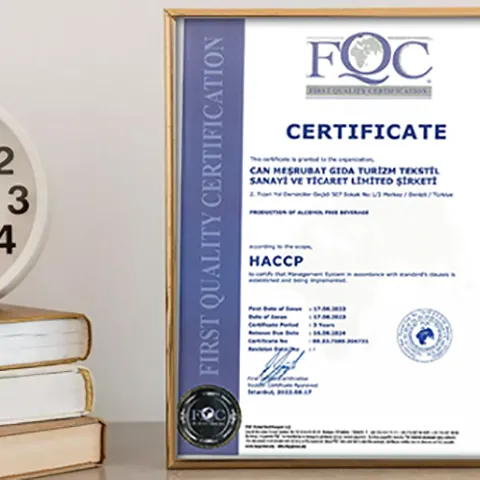
A HACCP training credential, a manufacturer food safety audit certificate, and statutory regulatory compliance represent distinct operational tiers. Beverage brand founders evaluating contract manufacturing partners must look beyond decorative wall plaques and audit specific scope documents.
For facilities holding comprehensive Global Food Safety Initiative (GFSI) recognitions, our guide on ISO certified beverages details how ISO 22000 and FSSC 22000 integrate HACCP into plant-wide management structures. Before approving a production partner, request documented proof that the co-packer validated process lethality for your specific ingredient blend and container geometry.
Hospitality groups, retail chains, and beverage entrepreneurs seeking contract formulation and certified packaging can collaborate with our accredited team as a premier wholesale exotic drinks supplier for validated, audit-ready bottling solutions.
Frequently Asked Questions
Q.What does HACCP stand for in beverage manufacturing?
It means Hazard Analysis and Critical Control Point. It is a structured approach to identifying significant food safety hazards and controlling them through suitable procedures, limits, checks, and records.
Q.Is HACCP mandatory for every commercial juice producer?
Requirements depend on the jurisdiction and activity. US Part 120 covers specified juice processing operations and includes exclusions and exceptions. Retail operations still have applicable food safety duties. Do not apply US provisions to every country.
Q.What is the difference between HACCP and GMP?
GMP provides basic hygienic conditions and working practices. HACCP addresses significant hazards through a product- and process-specific plan. A plant needs suitable hygiene foundations as well as its hazard controls.
Q.What is a CCP in a beverage plant?
A critical control point is a step where control is essential to prevent, eliminate, or reduce a food safety hazard to an acceptable level. The hazard analysis determines CCPs; there is no fixed list for all drinks.
Q.What does five-log pathogen reduction mean?
It means a 100,000-fold reduction in the pertinent microorganism where the US juice provision applies. It is not sterility or control of every hazard. The regulation contains scope and treatment exceptions.
Q.Can cold-pressed juice use a nonthermal treatment?
A suitable nonthermal treatment may be used if validated for the product, target hazard, equipment, and applicable requirements. Cold pressing alone is not a pathogen-reduction treatment. HPP is not a blanket solution for low-acid spore hazards.
Q.What is a flow diversion valve?
It can redirect product when the required process conditions are not met. Its safe state and response depend on the installed system. Valve movement alone does not prove that no affected product reached filling.
Q.Which pathogen matters most in acidic juice?
There is no single answer for every juice. Organisms such as E. coli, Salmonella, or Cryptosporidium may need assessment. The pertinent microorganism must be selected on a justified product-specific basis.
Q.What is Alicyclobacillus?
It is a group of bacteria associated with juice spoilage. A. acidoterrestris can produce guaiacol-related off-flavors. This quality concern should not be confused with the pathogen target used to validate a safety treatment.
Q.How often should metal detectors be challenge tested?
Use a justified frequency in the approved procedure, considering equipment, product, risk, and applicable requirements. There is no universal hourly rule or test-piece size for all beverage lines. Assess rejection as well as detection.
Q.What happens after a critical limit is breached?
Follow the approved response, contain potentially affected product, investigate the cause, and obtain a qualified disposition decision. Document the event and authorized restart. A repair alone does not authorize product release.
Q.How long should beverage HACCP records be stored?
Requirements vary. US juice records generally need one year for perishable or refrigerated products. Frozen, preserved, and shelf-stable products need two years or shelf life, whichever is longer, measured from preparation. Other duties may add time.
Q.What role does water treatment play?
Water must be suitable for its intended use. Assess its source, treatment, storage, and distribution. Filtration, reverse osmosis, or UV may be useful, but no single treatment train is mandatory or effective for every hazard.
Q.How does HACCP address allergens?
Assess ingredient risks, cross-contact, rework, cleaning, changeover, and correct labeling. Choose verification methods suited to the allergen and process. A generic hygiene swab does not prove allergen removal.
Q.Can a small juice bar operate without a federal juice HACCP plan?
A US retail establishment may fall outside Part 120, but local requirements still apply. Wholesale activity can change the assessment. Size, bottling, and on-site consumption alone do not settle every legal question.
Q.What are the five preliminary HACCP steps?
Assemble the team, describe the product, identify intended use and consumers, draw the process flow, and verify it on site. These tasks establish the information needed for the seven principles.
Q.What are the seven HACCP principles?
Analyze hazards, determine CCPs, set critical limits, establish monitoring, establish corrective actions, validate and verify the system, and keep records. The detailed application must fit the product and relevant framework.
Q.Does pH mean titratable acidity?
No. They describe different aspects of acidity and use different methods. Brix and water activity are also distinct measurements. Product specifications should identify the right property, method, and unit.
Q.Is a HACCP certificate enough to approve a co-packer?
No. Check its validity and scope, then examine evidence for your product and process. A certificate does not prove the treatment of a particular lot or guarantee every retailer's acceptance.
Q.Can a generic online SOP be used to test a live line?
Not without site-specific technical approval, risk assessment, and trained personnel. Test methods, limits, safeguards, and recovery steps must suit the equipment. A publication is not authority to bypass or interrupt protective controls.
Editorial Fact-Checking and Evidence Standards
- Statutory Regulatory Precision: All regulatory citations reference current electronic Code of Federal Regulations (eCFR) Title 21 Part 120 and UK Food Standards Agency statutes.
- Zero Generic Numerical Assertions: Thermal processing times, D-values, and holding tube configurations reflect validated principles rather than arbitrary industrial templates.
- Active Primary Reference Requirement: 100% of cited authorities, standards organizations, and compliance bodies are accessible via outbound hyperlinks.
Sources and References
- U.S. FDA eCFR - 21 CFR Part 120: Hazard Analysis and Critical Control Point (HACCP) Systems
- U.S. FDA - HACCP Principles and Application Guidelines
- U.S. FDA - Guidance for Industry: Juice HACCP and the FDA Food Safety Modernization Act
- Codex Alimentarius Commission - General Principles of Food Hygiene (CXC 1-1969)
- UK Food Standards Agency (FSA) - Food Safety Management and HACCP Principles
- U.S. FDA - Guidance for Industry: Action Levels for Poisonous or Deleterious Substances in Food (Patulin)



Comments and reviews (0)