


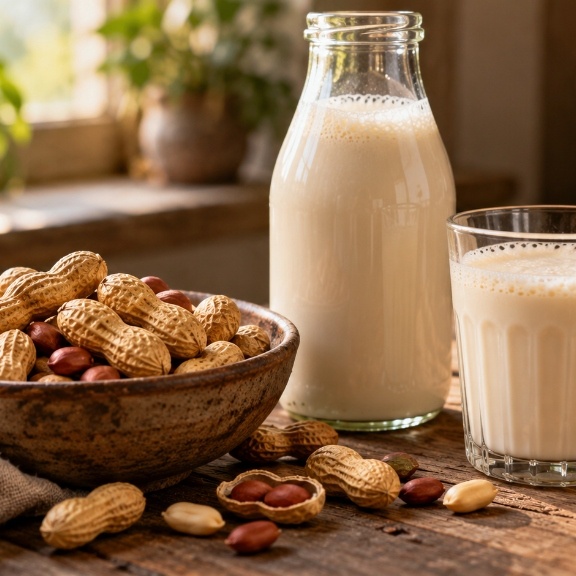
Most grocery store plant milks carry a major nutritional drawback: they provide almost no dietary protein. Almond and cashew milks taste light and refreshing, but with only 1 gram of protein per cup, they leave you hungry an hour later. Buying fortified specialty cartons every week quickly inflates your grocery bill.
What Is Peanut Milk?
Peanut milk is a dairy-free plant milk made by blending soaked peanuts (Arachis hypogaea) with water and straining out the fibrous meal. Unlike commercial almond milk, which supplies only 1 gram of protein per serving, fresh peanut milk delivers 6 to 8 grams of natural complete protein per cup. That directly rivals whole cow milk and soy milk at a fraction of the cost, making it the highest-protein homemade plant milk available.
Peanut Allergy Alert: Peanuts are one of the "Big 9" major food allergens recognized under the US Food Allergen Labeling and Consumer Protection Act (FALCPA). Ingesting peanut milk can trigger severe, life-threatening anaphylaxis in individuals with diagnosed peanut allergies. Clearly label all storage containers in shared households.
Peanut Milk at a Glance
| Feature | Specification |
|---|---|
| Botanical Source | Arachis hypogaea (Peanut / Groundnut – Legume Family) |
| Natural Protein Content | 6.0 to 8.0 g per 8 oz cup (Directly matches cow milk and soy milk) |
| Flavor Varieties | Raw blanched peanuts yield mild, neutral milk; roasted peanuts yield golden liquid peanut butter |
| Key Micronutrients | High in natural magnesium (50 mg), potassium, resveratrol, and L-arginine |
| Average Ingredient Cost | Approx. $0.75 per quart (Up to 70% cheaper than commercial almond or oat milk) |
| Culinary Versatility | Protein smoothies, West African groundnut stews, satay marinades, spicy ramen broths |
Is Peanut Milk a Tree Nut Milk or Legume Milk?
Despite sharing the word "nut" in its colloquial name, peanut milk is a legume milk, not a tree nut milk. Peanuts are edible seeds that develop inside underground pods belonging to the botanical family Fabaceae—the same plant family as soybeans, lentils, and chickpeas.
This legume classification explains why peanut milk contains vastly more protein than almond, cashew, or other plant milks. Legumes are naturally dense in storage proteins known as globulins (specifically arachin and conarachin) which dissolve readily in water during high-speed blending.
Peanut Milk vs. Almond Milk vs. Soy Milk vs. Cow Milk: Protein Showdown
When making almond milk at home, straining removes nearly all protein with the fibrous pulp, leaving behind nut-scented water with only 1 gram of protein per cup. In contrast, the water-soluble proteins in peanuts stay in the liquid even after straining:
| Nutritional Metric (1 Cup) | Fresh Peanut Milk | Almond Milk (Unsweetened) | Commercial Soy Milk | Whole Cow Milk (3.25%) |
|---|---|---|---|---|
| Calories | 120 to 140 kcal | 30 to 40 kcal | 80 to 90 kcal | About 150 kcal |
| Protein | 6.0 to 8.0 g | 1.0 g | 7.0 to 8.0 g | 8.0 g |
| Total Fat | 10.0 g (Monounsaturated) | 2.5 g | 4.0 g | 8.0 g (Predominantly saturated) |
| Carbohydrates | 4.0 g (Zero added sugar) | 1.0 to 2.0 g | 4.0 g | 12.0 g (Lactose sugar) |
| Naturally Lactose-Free? | Yes | Yes | Yes | No |
| Natural Magnesium | High (Approx. 50 mg) | Low (Approx. 15 mg) | Moderate (Approx. 40 mg) | Moderate (Approx. 25 mg) |
The History of Peanut Milk: From Ancient Roots to George Washington Carver
While modern coffee shops treat peanut milk as a trendy new craft beverage, its history spans hundreds of years across South America, West Africa, and the American South:
- Pre-Columbian South America: Peanuts originated in Bolivia, Peru, and northern Argentina. Archaeological excavations reveal that indigenous civilizations ground wild peanuts with water to produce energy drinks long before transatlantic trade.
- George Washington Carver's 1919 Patent: In 1919 at Alabama's Tuskegee Institute, American agricultural scientist George Washington Carver developed a standardized process for commercial peanut milk (U.S. Patent No. 1,394,456). Carver demonstrated that peanut milk was inexpensive to manufacture, highly nutritious, and shelf-stable for rural families without refrigeration.
- West African Groundnut Milk: Known as groundnuts across Nigeria, Ghana, and Senegal, families have brewed fresh groundnut milk for generations, flavoring it with fresh ginger and date syrup or simmering it into kunun gyada.
How to Make Fresh Peanut Milk (Step-by-Step Stovetop Recipe)
Making fresh peanut milk at home takes just 15 minutes of active preparation. For a silky, neutral beverage that mixes cleanly into coffee without strong peanut butter aromas, always choose raw blanched peanuts (peanuts with their papery skins removed).
High-Protein Homemade Peanut Milk
Ingredients
- 1 cup raw blanched peanuts (unsalted)
- 4 cups cold filtered water (for blending) | 3 cups water (for soaking)
- Small pinch of fine sea salt
- Optional: 2 pitted Medjool dates or 1/2 tsp vanilla extract
Step-by-Step Instructions
- Soak Peanuts: Place raw peanuts in a bowl, cover with 3 cups water, and soak for 6 to 8 hours in the refrigerator. Drain and rinse under cold water.
- Blend on High: Place rinsed peanuts, 4 cups cold filtered water, salt, and optional dates in a high-speed blender. Blend on high for 60 to 90 seconds until creamy and frothy.
- Strain: Pour the liquid through a fine-mesh nut milk bag over a large bowl. Squeeze firmly downward to extract all milk, leaving behind dry peanut pulp.
- 5-Minute Simmer (Key Step): Pour strained milk into a small saucepan over medium-low heat. Bring to a gentle simmer for 5 minutes, whisking constantly. This gentle heat deactivates lipoxygenase enzymes (removing beany off-flavors) and improves protein digestibility.
- Chill and Bottle: Allow milk to cool, transfer into a sealed glass bottle, and refrigerate for at least 2 hours before serving. Keeps fresh for 4 to 5 days.
Frequently Asked Questions About Peanut Milk
Q. How much protein is in a cup of peanut milk?
A standard 8-ounce cup of homemade peanut milk contains between 6 and 8 grams of complete plant protein, matching cow milk and soy milk while providing up to eight times more protein than commercial almond milk.
Q. Does peanut milk taste like liquid peanut butter?
If prepared with raw blanched peanuts and gently simmered, it produces a mild, neutral, creamy milk comparable to unsweetened soy milk. If prepared with roasted peanuts, it carries a bold, toasted flavor resembling liquid peanut butter.
Q. Can you froth peanut milk for coffee?
Yes. Because peanut milk naturally contains 6 to 8 grams of protein and healthy unsaturated fats, it steams into dense, glossy microfoam that holds latte art without curdling or separating.
Q. Can people with tree nut allergies drink peanut milk?
Peanuts are underground legumes, not tree nuts. While some individuals with tree nut allergies can safely eat peanuts, clinical studies show that 20% to 40% of people with peanut allergies also react to tree nuts. Always consult an allergist before trying peanut milk.
The Bottom Line
Summary and Practical Takeaways
Peanut milk is an affordable, nutrient-dense powerhouse in the plant milk universe, packing whole-milk protein levels with zero dairy or lactose.
- High Protein Champion: Supplies 6 to 8 grams of natural complete protein per cup, beating almond milk by up to 800 percent.
- Choose Raw Blanched: Using raw blanched peanuts produces a neutral, silky milk perfect for coffee, cooking, and everyday drinking.
- Unbeatable Affordability: Blending your own peanut milk costs under $0.80 per quart—far cheaper than packaged supermarket cartons.
- Severe Allergen Warning: Peanuts are a major food allergen; clearly label containers and keep strictly separate from allergic individuals.
Sources and Review Standards
- U.S. Department of Agriculture (USDA) FoodData Central: Raw Peanuts (FDC ID 172430) and Legume Protein Fractionation
- U.S. Food and Drug Administration (FDA): Food Allergen Labeling and Consumer Protection Act (FALCPA)
- United States Patent Office: US Patent No. 1,394,456 (George Washington Carver: Process of Producing Peanut Milk)
- National Institutes of Health (PubMed): Thermal Inactivation of Lipoxygenase and Protein Bioavailability in Groundnut Beverages







Comments and reviews (0)