


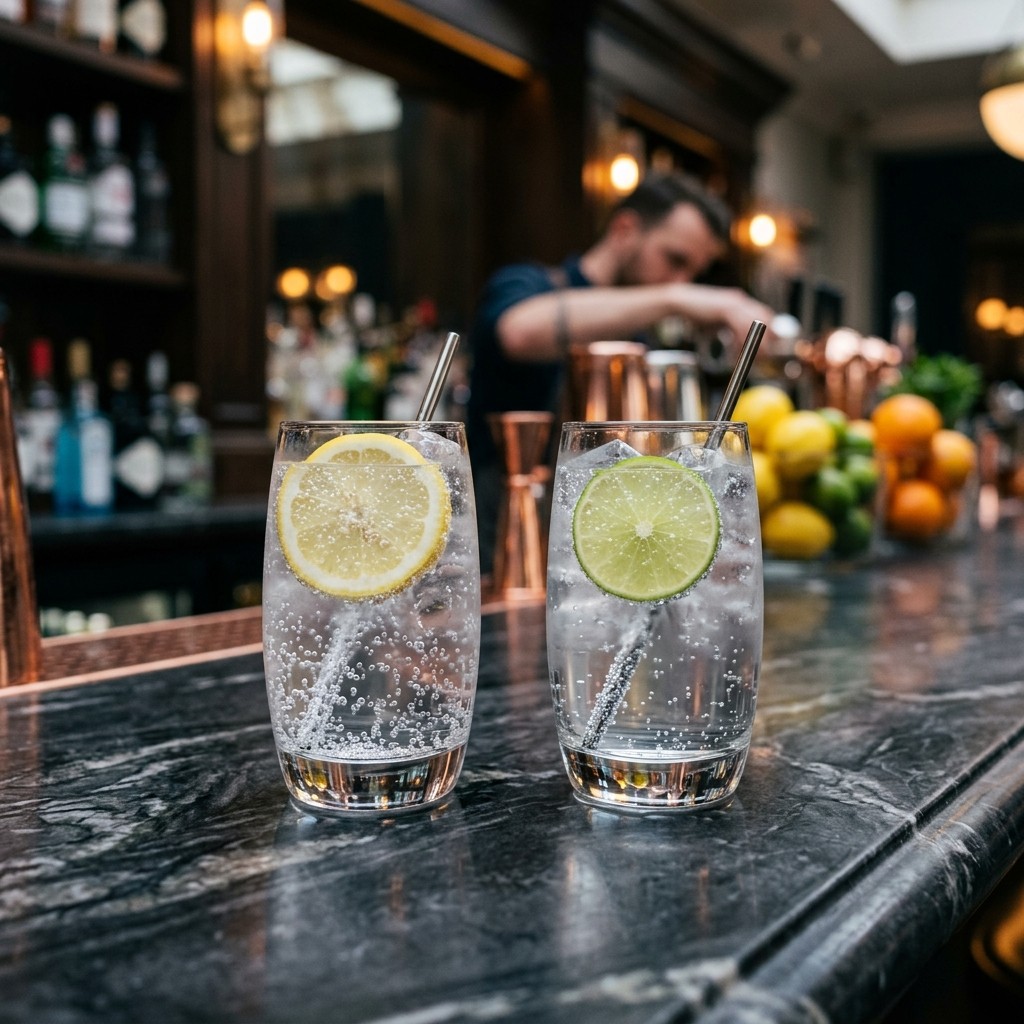
Club soda vs tonic water looks like a simple comparison. Both are clear, fizzy mixers, but their ingredients and flavors are very different.
What Is the Difference Between Club Soda and Tonic Water?
Club soda is carbonated water with added mineral salts. It usually has no sugar or calories and tastes clean, crisp, and slightly salty. Tonic water contains quinine, sweetener, and often citric acid. It tastes bitter and sweet. A regular 12-ounce tonic can contain about 130 calories and 33 grams of added sugar, while a comparable club soda may have 0 calories and 0 grams of sugar. Check the label because formulas vary.
Club Soda vs. Tonic Water at a Glance
| Feature | Club Soda | Tonic Water |
|---|---|---|
| Base | Carbonated water | Carbonated water |
| Main added ingredients | Mineral salts | Quinine, sweetener, acid, and flavoring |
| Taste | Clean, crisp, and slightly mineral | Bitter, sweet, and often citrus-like |
| Sugar | Usually 0 grams | Regular versions often contain 30g+ added sugar |
| Calories | Usually 0 | Regular versions often contain 120-130 kcal |
| Quinine | None | Present (up to 83 ppm, FDA limit) |
| Typical sodium | 50 to 95 mg per 12 oz | 15 to 55 mg per 12 oz |
| Best-known uses | Vodka soda, whiskey highball, Tom Collins, and spritzes | Gin and tonic, vodka tonic, and port and tonic |
| Simple substitution | Makes a drier, less bitter drink | Makes a sweeter, more bitter drink |
The difference between club soda and tonic water starts with flavor. Club soda stays in the background, adding neutral effervescence. Tonic water changes the drink entirely with sweetness and botanical quinine bitterness.
What Is Club Soda?
Club soda is water infused with carbon dioxide under pressure. Bottlers add mineral salts to round out its mouthfeel and deliver a crisp, lightly salty finish:
- Sodium Bicarbonate: Buffers carbonation acidity and adds gentle mineral smoothness.
- Potassium Sulfate: Enhances crispness across the mid-palate.
- Sodium Chloride: Standard table salt that elevates volatile botanical aromas.
- Disodium Phosphate: Helps maintain mineral solubility during storage.
For example, standard US Schweppes club soda contains carbonated water, sodium bicarbonate, salt, and potassium sulfate. One 12-ounce serving delivers 0 calories, 0 grams of sugar, and 95 milligrams of sodium.
What Is Tonic Water? Quinine and Sugar
Tonic water is a carbonated soft drink flavored with quinine. Regular versions contain sugar or high fructose corn syrup to offset the natural bitterness of the quinine bark:
A standard 12-ounce can of commercial tonic water packs roughly 130 calories and 33 grams of added sugar, matching the sugar load of standard cola. Diet tonic waters use sucralose or stevia to eliminate sugar while retaining the bitter profile.
Nutrition Comparison: Schweppes 12 fl oz Serving
| Nutrient (per 12 fl oz) | Schweppes Club Soda | Schweppes Tonic Water |
|---|---|---|
| Calories | 0 kcal | 130 kcal |
| Total Carbohydrates | 0 g | 33 g |
| Added Sugars | 0 g | 33 g |
| Sodium | 95 mg | 55 mg |
| Quinine | No | Yes |
What Is Quinine and Why Is It in Tonic Water?
Quinine is a naturally occurring compound extracted from the bark of the cinchona tree native to South America. It has a historic medical legacy as a primary treatment and prophylactic against malaria.
British colonial soldiers stationed in India drank daily quinine rations dissolved in water. Because pure quinine is intolerably bitter, officers blended it with sugar, lime, and London dry gin, giving rise to the Gin and Tonic.
FDA 83 PPM Ceiling on Quinine
Under 21 CFR 172.575, the U.S. FDA restricts quinine in carbonated drinks to a strict maximum of 83 parts per million (ppm). This ceiling delivers the traditional bitter bite without causing cinchonism or pharmacological side effects.
Why Tonic Water Glows Under Blacklight
Quinine molecules absorb invisible ultraviolet (UV) light at approximately 350 nanometers and re-emit that energy as lower-energy visible light at roughly 450 nanometers. This photochemical reaction causes clear tonic water to glow bright electric blue under a UV blacklight.
Club soda lacks quinine, so it remains completely dark and clear under UV light.
Club Soda vs. Tonic Water in Cocktails
Each mixer serves a specific purpose in bartending:
| Drink | Better Mixer | Reason |
|---|---|---|
| Gin and tonic | Tonic water | Quinine bitterness complements juniper and citrus botanicals |
| Gin soda | Club soda | Keeps the drink dry and lets delicate spirit notes lead |
| Vodka soda | Club soda | Adds crisp effervescence with zero sugar or calories |
| Tom Collins | Club soda | The recipe already receives sweetness from simple syrup |
| Mojito | Club soda | Adds bubbles without covering fresh muddled mint and lime |
| Port and tonic | Tonic water | Quinine bitterness balances rich sweet fortified white port |
How to Substitute Club Soda for Tonic Water
- Add 1 1/2 ounces gin (or zero-proof spirit) to an ice-filled highball glass.
- Pour in 4 ounces chilled club soda.
- Add 1/4 ounce simple syrup to restore missing body and sweetness.
- Squeeze in a fresh lime wedge and express grapefruit peel over the rim for aromatic citrus oils.
This simple ratio restores sweetness and citrus brightness, though quinine bitterness will remain absent.
Frequently Asked Questions
Q. Is club soda just plain carbonated water?
No. Plain carbonated water without additives is seltzer. Club soda contains added mineral salts such as sodium bicarbonate and potassium sulfate to soften acidity and provide mouthfeel.
Q. Can tonic water treat night-time leg cramps?
No. The FDA warns that commercial tonic water contains far too little quinine (under 83 ppm) to treat leg cramps, and prescription quinine carries significant medical risks.
Q. Is diet tonic water the same as club soda?
No. Diet tonic water still contains quinine and tastes sweet and bitter via non-nutritive sweeteners. Club soda contains mineral salts and has a clean, slightly salty taste.
Q. Does club soda contain caffeine?
Standard plain club soda is 100% caffeine-free.
The Bottom Line
Summary and Practical Takeaways
Club soda is the practical choice for clean fizz, zero sugar, and no calories. Tonic water is the right mixer when a drink requires botanical quinine bitterness and sweetness. When substituting club soda for tonic in cocktails, add a dash of simple syrup and fresh citrus to restore body and balance.
Sources and Review Standards
- U.S. Food and Drug Administration (FDA): 21 CFR 172.575 Quinine in Carbonated Beverages
- U.S. Department of Agriculture (USDA) FoodData Central: Tonic Water Nutrient Analysis
- U.S. Food and Drug Administration (FDA): Quinine Safety Advisory and Off-Label Cramp Warnings
- Centers for Disease Control and Prevention (CDC): The History of Malaria and Cinchona Tree Prophylaxis
- Schweppes US: Current Club Soda and Tonic Water Formulations and Nutrition





Comments and reviews (0)